Category Archives: Technology innovation

If it’s easy, it gets used. Mobile makes booking business travel as easy as child’s play.

kids-and-cell-phones

Today a travelling sales executive from Des Moines, Iowa, has the same knowledge and information in the palm of their hand that only the president of the United States did 20 years ago. Smartphones and tablets used to review our business trip details on now have more processing power than the Apollo moon landing spacecraft.

Computing power continues to double every two years – as defined by Moore’s Law – while prices continue to drop. This means that computers are being built twice as powerful but without costing twice as much as before every two years, and this law has already held good for 50 years. Technology today takes what used to be scarce and makes it abundant, over and over again. With knowledge and information so freely available, access to it is less costly and at the fingertips of billions of people the world over. Steve Jobs surely smiled at this particular ‘dent in the universe’.

Low-cost-entry for web-based digital technology coupled with software development cycles and lead times constantly reducing can only mean this accelerated exponential growth is set to continue. As a direct consequence expect a heady stream of disruptive innovation as a constant factor in almost every facet of our business and personal lives.

I’m repeating what plenty of industry commentators have expressed about technology-driven disruption, but focusing on a big shift being seen in the corporate travel sector. Step up disruptors like AirBnB and Uber that target a new generation of business travellers armed with smartphones who are getting more and more comfortable making their own buying decisions, often while on the move and sometimes contrary to their company’s travel purchasing policies.

But to what extent is this behaviour undermining companies with centralised corporate purchasing directives? Examining key trends on what people are actually doing starts to tell the story.

Recent research from xAd (a location-based mobile advertising tech company based in the UK) has shown that 29% of consumers admitted using a smartphone as the only tool they use to make purchasing decisions. And whatever happens in the consumer world soon enough surfaces in the business world too.
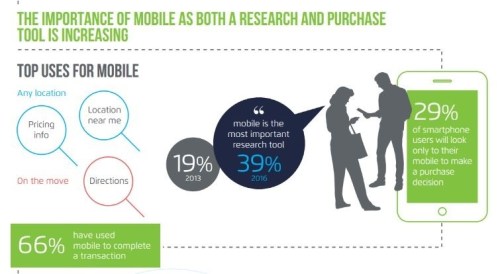
29 per cent only use mobile_purchasing

Note also that 56% of consumers buy immediately or within 1-hour after researching. The always on nature of mobile means more attention needs to be paid on how to engage and influence people at the right time and in the right place – wherever in the world they might be.

Drilling down into specific behaviour of business travellers, the trend is clear. Research from Google Ipsos Media on US travellers in 2015 shows that just over half booked travel on their smartphones.
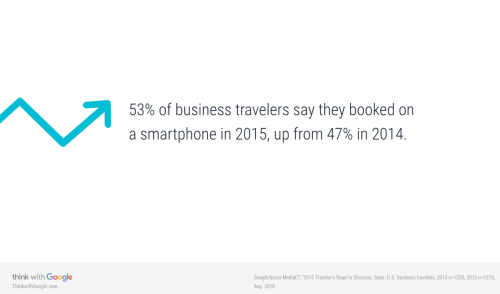
Google Think US travellers book on smartphone

Interestingly too, US business travellers are more inclined to use travel apps on their smartphones to book travel – 63% of them compared to 55% who access a website via their smartphone to book travel.*
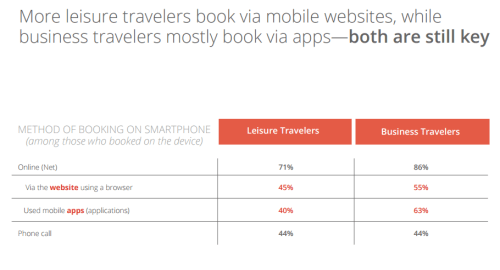
Think with Google 2014 US travelers using mobile to book

* Extract from Google Ipsos Media ‘2014 Traveler’s Road to Decision’.


A recently published GBTA (Global Business Travel Association) and Carlson Foundation study www.tnooz.com/article/business-travel-mobile has shown that despite the emergence of mobile travel apps around 2009 and the subsequent growth in usage by business travellers, TMCs (Travel Management Companies) and their corporate clients haven’t responded sufficiently or quickly enough to this behavioural shift.

The study highlights that 69% of ‘Travel Professionals’ admit that their programme doesn’t have a mobile strategy in place. Although, most to plan to do so within the next 2 years – 64% of respondents, with another 24% saying they’ll devise a strategy in the next 3 years.

With the growing number of business travellers using smartphones for travel purchases, getting service messages and updates directly from travel suppliers, like airlines and hotels, and using various apps to find their way around a new business destination, it would seem that their company’s travel department and TMC need to apply more haste on this issue.

If not, this generally widespread hesitant approach risks undermining corporate purchasing policies and programmes designed to support an organisation’s business goals while minimising travel-related spend and achieving desired levels of productivity from employees travelling on business.

Or in the future, will organisations just trust their travelling executives to do the right thing – using whatever mobile technology offers to make the right travel buying choices?

Re-boot of this blog…

I’ve left a couple of posts from 6-years ago. Reading them now brought a wry smile to my face. Back then I commented on the then launch of the iPad; convergence of content films, games and social media via gaming consoles and what a ‘dark-horse’ it was; plus how the 2008/9 financial crash caused an inevitable downturn in business travel which led to attention from market leaders on selling to SME customers…I wonder if we’ll see a repeat of that post-Brexit?

Are We Living The Future?

Science-fiction writers, like Isaac Asimov (I, Robot) in the 1940’s and Arthur C Clarke (2001 A Space Odyssey) in the 1960’s, published stories that projected how humankind and our world might be fifty-years ahead of their time. But of course, we’re now seeing things once dreamed of as science-fiction unfold on what seems like an almost daily basis.

Our ‘virtual revolution’ is driven by internet-related technologies and in one instance by thinking that was arguably first outlined by Vannevar Bush (no relation to George W, by the way) in 1945. He imagined flat TV-like screens embedded in desks which could literally access content from the greatest libraries in the world ~ giving anyone and everyone access to ‘all’ written human knowledge.

In his own words, published in The Atlantic Magazine* (July 1945) under the title ‘As We May Think’, he suggested…

“Consider a future device for individual use, which is a sort of mechanized private file and library. It needs a name, and, to coin one at random, “memex” will do.

A memex is a device in which an individual stores all his books, records, and communications, and which is mechanized so that it may be consulted with exceeding speed and flexibility. It is an enlarged intimate supplement to his memory.

It consists of a desk, and while it can presumably be operated from a distance, it is primarily the piece of furniture at which he works. On the top are slanting translucent screens, on which material can be projected for convenient reading. There is a keyboard, and sets of buttons and levers. Otherwise it looks like an ordinary desk.

In one end is the stored material. The matter of bulk is well taken care of by improved microfilm. Only a small part of the interior of the memex is devoted to storage, the rest to mechanism. Yet if the user inserted 5000 pages of material a day it would take him hundreds of years to fill the repository, so he can be profligate and enter material freely.”

(Although he talks about the use of computer machines elsewhere in the full article, he presupposes that microfilm rather than digitized data would be the most effective storage platform. Give the guy a break! He had an extremely busy war!)

Anyway, perhaps you won’t be surprised to learn then that his ideas are said to have influenced and inspired early developments at Apple Computers Inc**. So it was inevitable that Apple would launch the iPad…Right?

Following it’s trailblazing iPhone, the iPod and iTunes, this latest offering (although it’s not the only ‘tablet’ device recently launched into the marketplace) may at last truly fulfill ‘Dr. Vannevar Bush’s Prophecy’. A (wireless) device that you can pretty much sit and read anywhere and that gives you access to a ‘world of multi-faceted and inter-related information’.

But it won’t all be work, work, work, Dr. Bush. No Sir.     

http://www.youtube.com/watch?v=R4PBTe-yC6M&feature=related

And to reinforce that point, last week Condé Nast announced it will create Apple iPad versions of its Wired, GQ, Vanity Fair, The New Yorker and Glamour magazines. Other titles from the Condé Nast stable that might follow could include; Vogue, Condé Nast Traveller, W and Gourmet.

An iPad version of GQ will be ready next month (April) shortly after Apple begins shipping its first tablet computers later this month, and will be sold via iTunes.

How the advertising will be presented on the iPad is a key concern for Condé Nast and it is looking at ideas such as how users might be able to click through from an ad straight to an e-commerce store.

So ‘the future’ will be available from $499 at an Apple store near you from 03 April (If you live in the US and sometime towards the end of April for those of us in the UK).    


* http://www.theatlantic.com/magazine/archive/1969/12/as-we-may-think/3881/1/


 ** Insanely Great by Steven Levy (The story of Apple’s early days)

http://www.amazon.com/Insanely-Great-Macintosh-Computer-Everything/dp/0140291776