
I’ve left a couple of posts from 6-years ago. Reading them now brought a wry smile to my face. Back then I commented on the then launch of the iPad; convergence of content films, games and social media via gaming consoles and what a ‘dark-horse’ it was; plus how the 2008/9 financial crash caused an inevitable downturn in business travel which led to attention from market leaders on selling to SME customers…I wonder if we’ll see a repeat of that post-Brexit?
Category Archives: Web convergence
Are We Living The Future?
Science-fiction writers, like Isaac Asimov (I, Robot) in the 1940’s and Arthur C Clarke (2001 A Space Odyssey) in the 1960’s, published stories that projected how humankind and our world might be fifty-years ahead of their time. But of course, we’re now seeing things once dreamed of as science-fiction unfold on what seems like an almost daily basis.
Our ‘virtual revolution’ is driven by internet-related technologies and in one instance by thinking that was arguably first outlined by Vannevar Bush (no relation to George W, by the way) in 1945. He imagined flat TV-like screens embedded in desks which could literally access content from the greatest libraries in the world ~ giving anyone and everyone access to ‘all’ written human knowledge.
In his own words, published in The Atlantic Magazine* (July 1945) under the title ‘As We May Think’, he suggested…
“Consider a future device for individual use, which is a sort of mechanized private file and library. It needs a name, and, to coin one at random, “memex” will do.
A memex is a device in which an individual stores all his books, records, and communications, and which is mechanized so that it may be consulted with exceeding speed and flexibility. It is an enlarged intimate supplement to his memory.
It consists of a desk, and while it can presumably be operated from a distance, it is primarily the piece of furniture at which he works. On the top are slanting translucent screens, on which material can be projected for convenient reading. There is a keyboard, and sets of buttons and levers. Otherwise it looks like an ordinary desk.
In one end is the stored material. The matter of bulk is well taken care of by improved microfilm. Only a small part of the interior of the memex is devoted to storage, the rest to mechanism. Yet if the user inserted 5000 pages of material a day it would take him hundreds of years to fill the repository, so he can be profligate and enter material freely.”
(Although he talks about the use of computer machines elsewhere in the full article, he presupposes that microfilm rather than digitized data would be the most effective storage platform. Give the guy a break! He had an extremely busy war!)
Anyway, perhaps you won’t be surprised to learn then that his ideas are said to have influenced and inspired early developments at Apple Computers Inc**. So it was inevitable that Apple would launch the iPad…Right?
Following it’s trailblazing iPhone, the iPod and iTunes, this latest offering (although it’s not the only ‘tablet’ device recently launched into the marketplace) may at last truly fulfill ‘Dr. Vannevar Bush’s Prophecy’. A (wireless) device that you can pretty much sit and read anywhere and that gives you access to a ‘world of multi-faceted and inter-related information’.
But it won’t all be work, work, work, Dr. Bush. No Sir.
http://www.youtube.com/watch?v=R4PBTe-yC6M&feature=related
And to reinforce that point, last week Condé Nast announced it will create Apple iPad versions of its Wired, GQ, Vanity Fair, The New Yorker and Glamour magazines. Other titles from the Condé Nast stable that might follow could include; Vogue, Condé Nast Traveller, W and Gourmet.
An iPad version of GQ will be ready next month (April) shortly after Apple begins shipping its first tablet computers later this month, and will be sold via iTunes.
How the advertising will be presented on the iPad is a key concern for Condé Nast and it is looking at ideas such as how users might be able to click through from an ad straight to an e-commerce store.
So ‘the future’ will be available from $499 at an Apple store near you from 03 April (If you live in the US and sometime towards the end of April for those of us in the UK).
* http://www.theatlantic.com/magazine/archive/1969/12/as-we-may-think/3881/1/
** Insanely Great by Steven Levy (The story of Apple’s early days)
http://www.amazon.com/Insanely-Great-Macintosh-Computer-Everything/dp/0140291776
“Let the Games Begin…”
The voice-over smoothly signs off with “…the game is just the start” in the current ad campaign for Sony’s latest iteration of its PlayStation game console. Better than that, the ad voice-over kicks off with “Start up more than games” and continues with “start a home entertainment REVOLUTION”.
He doesn’t actually shout or speak in block capital letters to emphasize the point. I just wrote it that way because while everybody’s expecting a mobile/digital TV/broadband play to deliver the (apparently) holy grail of convergence, game consoles are kind of sneaking up to grab the big prize.
And what exactly does the disembodied voice in the PS3 ad campaign mean by “home entertainment revolution”?
How about being able to access BBC iPlayer to catch up with your favourite TV shows and films! And when you factor in the matching offer from Microsoft’s XBOX 360, boy will you want to ‘jump in’. And don’t forget the Nintendo Wii either.
Each console is internet-enabled and allows ‘players’ (how much longer will they be called that?) to watch content from online TV catch-up services, download and play the latest DVD film releases e.g. ‘Ice Age 3 – Dawn of the Dinosaurs’, watch trailers for blockbuster films before they hit the cinemas and demo the latest games before they’re in the shops. And if this isn’t enough consumer engagement, with their PS3/Xbox360/Wii consoles, they’ll be able to audio-chat with friends while they’re playing games and hook up with friends on Facebook and Myspace or just tweet away on Twitter.
And then there are the games. But aren’t they’re just for kids?
Hold that thought ~ because the recent release of Call of Duty: Modern Warfare 2 shattered entertainment sales records to become the biggest launch in entertainment history – in its first five-days it grossed $550 million. This has beaten all previous first and five-day entertainment box office, book and game records – including ‘Harry Potter and the Half-Blood Prince’ which held the record for the highest grossing film over five days, racking up $394 million.
In fact, this first-person shoot-and-destroy war-based game sold 4.2 million copies in the UK and US in 24 hours. (Bet the manufacturer’s stock management logistics were on fire!)
In the UK alone, there are 12 million of the latest generation games consoles which can bring the TV and web together. When you also factor in handheld siblings, like PSP and Nintendo DS and Apple’s iPhone apps, you’re looking at reaching something like 24 million consumers. I’m calling them ‘consumers’ because it’s not just kids who play on consoles. Just look at the positioning of the Wii as ‘family-entertainment’ and the success of games like Dr. Kawashima’s ‘Brain Training’, not to mention the ‘older’ demographic that makes up the iPhone customer-base.
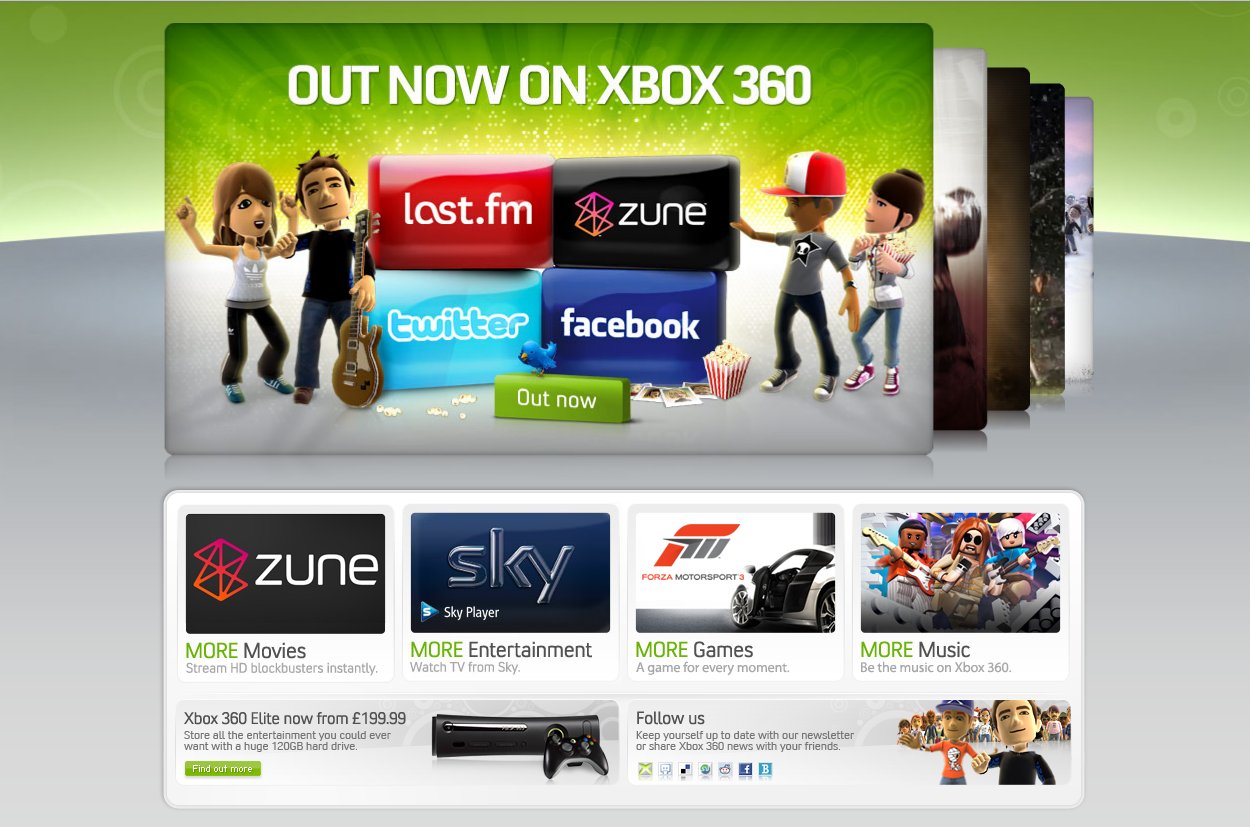
Xbox 360 Live offers Sky, Zune, Lastfm, Facebook, Twitter
There’s more evidence that points to a real sense of convergence. Mega-corporations like Sky has opened up access on Xbox 360 and the BBC has recently re-launched an improved version of iPlayer on the Nintendo Wii (18 November 2009). http://news.bbc.co.uk/1/hi/technology/8357777.stm
So, for an investment of £200-£300 plus an annual subscription (For example, Xbox 360 Live Gold annual membership is £30 ~ which is £2.50 a month) people can play games, watch TV, films and music videos, connect up with friends and family via Facebook et al – and do it all in the comfort of their living room and on whatever massive HD digital LED/Plasma TV screen they can afford!
By the way, I’m not particularly promoting Xbox. It just happens to be the games console my two boys just bought having clubbed together their savings and birthday money! (And they’ve had to start with the entry-level Xbox 360 Arcade).
Being a kid of the 21st Century is tough, eh?
Posted in Technology innovation, Web convergence
Tagged BBC iPlayer, Call of Duty: Modern Warfare 2, Facebook, Lastfm, Nintendo Wii, PS3, Sky, Xbox 360 Live, Zune
 Just Barry's Blog