Category Archives: Travel Management

If it’s easy, it gets used. Mobile makes booking business travel as easy as child’s play.

kids-and-cell-phones

Today a travelling sales executive from Des Moines, Iowa, has the same knowledge and information in the palm of their hand that only the president of the United States did 20 years ago. Smartphones and tablets used to review our business trip details on now have more processing power than the Apollo moon landing spacecraft.

Computing power continues to double every two years – as defined by Moore’s Law – while prices continue to drop. This means that computers are being built twice as powerful but without costing twice as much as before every two years, and this law has already held good for 50 years. Technology today takes what used to be scarce and makes it abundant, over and over again. With knowledge and information so freely available, access to it is less costly and at the fingertips of billions of people the world over. Steve Jobs surely smiled at this particular ‘dent in the universe’.

Low-cost-entry for web-based digital technology coupled with software development cycles and lead times constantly reducing can only mean this accelerated exponential growth is set to continue. As a direct consequence expect a heady stream of disruptive innovation as a constant factor in almost every facet of our business and personal lives.

I’m repeating what plenty of industry commentators have expressed about technology-driven disruption, but focusing on a big shift being seen in the corporate travel sector. Step up disruptors like AirBnB and Uber that target a new generation of business travellers armed with smartphones who are getting more and more comfortable making their own buying decisions, often while on the move and sometimes contrary to their company’s travel purchasing policies.

But to what extent is this behaviour undermining companies with centralised corporate purchasing directives? Examining key trends on what people are actually doing starts to tell the story.

Recent research from xAd (a location-based mobile advertising tech company based in the UK) has shown that 29% of consumers admitted using a smartphone as the only tool they use to make purchasing decisions. And whatever happens in the consumer world soon enough surfaces in the business world too.
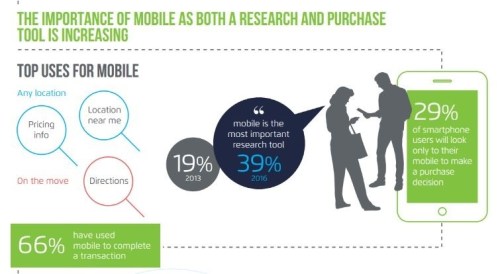
29 per cent only use mobile_purchasing

Note also that 56% of consumers buy immediately or within 1-hour after researching. The always on nature of mobile means more attention needs to be paid on how to engage and influence people at the right time and in the right place – wherever in the world they might be.

Drilling down into specific behaviour of business travellers, the trend is clear. Research from Google Ipsos Media on US travellers in 2015 shows that just over half booked travel on their smartphones.
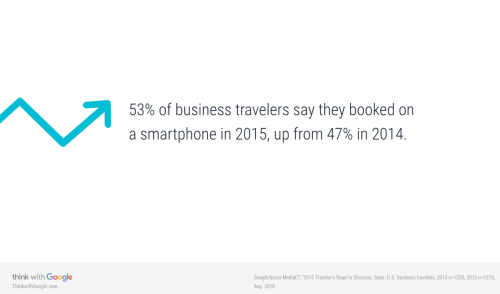
Google Think US travellers book on smartphone

Interestingly too, US business travellers are more inclined to use travel apps on their smartphones to book travel – 63% of them compared to 55% who access a website via their smartphone to book travel.*
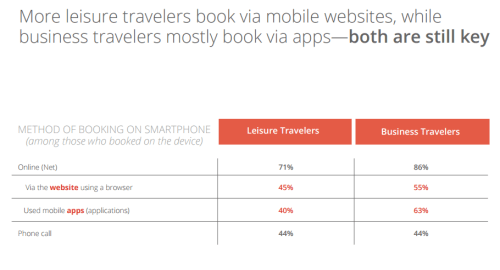
Think with Google 2014 US travelers using mobile to book

* Extract from Google Ipsos Media ‘2014 Traveler’s Road to Decision’.


A recently published GBTA (Global Business Travel Association) and Carlson Foundation study www.tnooz.com/article/business-travel-mobile has shown that despite the emergence of mobile travel apps around 2009 and the subsequent growth in usage by business travellers, TMCs (Travel Management Companies) and their corporate clients haven’t responded sufficiently or quickly enough to this behavioural shift.

The study highlights that 69% of ‘Travel Professionals’ admit that their programme doesn’t have a mobile strategy in place. Although, most to plan to do so within the next 2 years – 64% of respondents, with another 24% saying they’ll devise a strategy in the next 3 years.

With the growing number of business travellers using smartphones for travel purchases, getting service messages and updates directly from travel suppliers, like airlines and hotels, and using various apps to find their way around a new business destination, it would seem that their company’s travel department and TMC need to apply more haste on this issue.

If not, this generally widespread hesitant approach risks undermining corporate purchasing policies and programmes designed to support an organisation’s business goals while minimising travel-related spend and achieving desired levels of productivity from employees travelling on business.

Or in the future, will organisations just trust their travelling executives to do the right thing – using whatever mobile technology offers to make the right travel buying choices?

Re-boot of this blog…

I’ve left a couple of posts from 6-years ago. Reading them now brought a wry smile to my face. Back then I commented on the then launch of the iPad; convergence of content films, games and social media via gaming consoles and what a ‘dark-horse’ it was; plus how the 2008/9 financial crash caused an inevitable downturn in business travel which led to attention from market leaders on selling to SME customers…I wonder if we’ll see a repeat of that post-Brexit?

Back to the Future…

It may be the new ‘battleground’

And this pattern may be playing itself out in other marketplaces; wherever intermediaries serve both end-user customers and service provider suppliers. It’s that part of the market tagged (with the misnomer*) SME and in the UK corporate travel marketplace, battle is about to be joined.

Or is it? Bear in mind ‘herd-mentality’ doesn’t just occur in financial markets – and look where that got us.

However, even before this week’s Business Travel & Meetings Show took place at Earls Court, where FCm UK launched ‘Corporate Traveller’ ~ a rejuvenated brand aimed squarely at the SME business travel customer, there have been other indications of renewed efforts to focus more specifically on this loosely labeled part of the market. In September 2009 HRG, joint-ranked No. 2 in the UK marketplace and another global travel management company, announced its SME proposition and showed off its ‘Simply HRG’ brand with a new and dedicated web site. And just ahead of the aforementioned trade show, American Express Corporate Travel (joint-ranked No.2 in the UK**) announced it was re-naming/refreshing/re-launching (pick whichever you think fits best) its SME offer branded as ‘AXcent’.

Some may see this flurry of activity as an almost inevitable and cyclical reaction to the recent economic recession. It’s happened before; where the big (and now global) players struggle because a recession forces their equally big (and now global) clients to cut back on travel. And of course, when sales/transaction volumes go down (a dip of 20-30% during 2009) with such wafer-thin margins for travel management companies, so too does their income. But arguably, even in recessionary times, SME businesses who are the ‘little-guys’ still have to travel to sell or service their customers, and without any kind of volume spend they need help to hunt down the best deals.

Equally, there have been many travel industry commentators declaring that this recession (unlike previous downturns) is different. It has forced a fundamental step-change in corporate attitudes towards travelling on business. So the argument goes; CSR response to global warming, the use of virtual meeting web-based technologies and commercial pressures to minimise travel spending more than ever, all have caused a paradigm-shift ~ you don’t have to travel to do business globally anymore.

Maybe it’s true. Or perhaps a version of it is true. If you work for a global organisation, maybe the new paradigm is ~ you don’t have to travel so much to do business globally anymore.

Which neatly brings us back to the future. I suggest that the renewed focus on SME customers is occurring partly because of the recession, but partly because this kind of business customer with perhaps fewer travellers or travelling less often, needs a different kind of service proposition. One where value is driven by expertise and the ability to find and put together an itinerary featuring the best deals available on the day faster than the customer can themselves. Yes it’s harder to find and keep this kind of customer, but with a different cost base they generate better margins per transaction and healthier profits for travel management companies.

And it’s what the business travel agency service was originally all about.

* The definition of what a Small to Medium Sized Enterprise looks like seems to be open to interpretation – for example, some global travel management companies would classify an organisation spending £500,000 as an SME. Whereas for a small or mid-market agency, that kind of customer would probably be treated as one of their top-tier clients. And it’s not just the agencies that might risk misaligning client expectations. Airlines equally categorise clients by their total annual spend even when that spend is a small share of a client’s multi-million pound travel budget. The client may have a ‘mega-corp’ culture and expectations but they will be presented with an SME offer. In today’s complex world, SME is as descriptive as saying someone works in the ‘Travel Industry’ or the ‘Public Sector’. It could mean so many different things that it’s not actually that helpful.

** Market Rankings – according to Buying Business Travel 50 leading TMCs May/June 2008.